

De Bry Rare Books
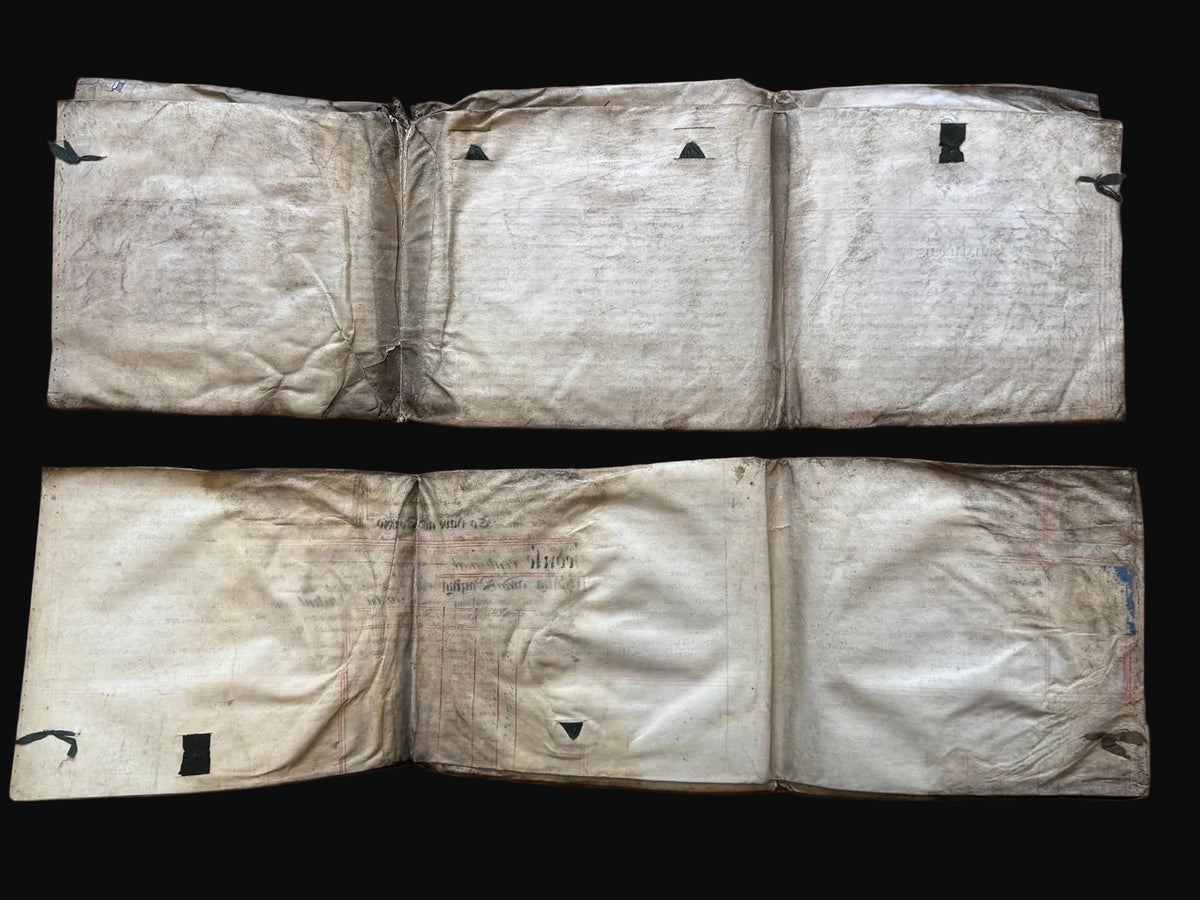
An archive of Nine vellum deeds documenting the enslaved populations of the Upper and Lower Pearl Estates in St Andrew's, Grenada, from 1826-1828, and their subsequent sale in 1830.
An archive of Nine vellum deeds documenting the enslaved populations of the Upper and Lower Pearl Estates in St Andrew's, Grenada, from 1826-1828, and their subsequent sale in 1830.
Couldn't load pickup availability
"Birth into slavery, Guinea marks, Suicide, and Branding"
An archive of nine vellum deeds and schedules documenting 317 enslaved people on the Upper and Lower Pearl Estates, St Andrew, Grenada, between 1826 and 1828, together with legal documents which transferred ownership of the estates in 1830.
Individuals on the Schedules for 1826-8:
Birth into slavery: "John Mark", aged nine months is recorded as being born into slavery to his mother "Jacquilaine", 29. His birth is dispassionately entered under “Increase”, reducing the birth of a child to an addition to the plantation’s enslaved population. Sadly the infant "Pt. Polite" died of fits at the age of 1 1/2 months, and is recorded as both an "increase" and a "decrease" on the deeds for the year 1827.
Suicide: “Leonard”, aged 41, is documented as having “Hanged himself”. His death appears among the “Decrease” of the plantation population, and suggests oppressive working conditions on the plantation.
Fatal Plantation accidents: "Daniel", a 40 year old black African man, "Died in consequence of falling into clarifying [sugar?] liquor". Clarifying liquor was the boiling cane juice, often manufactured in large copper vats, which was formed during the production of sugar from sugar cane. "Luke", a 66 year old black African man "Had his arm up to the shoulder taken off at Mt. Horne. Still died in consequence". This is possibly a reference to an accident involving rollers used to crush sugar cane, a well described injury on sugar plantations, often managed with swift amputation in an attempt to save the person's life. Mt Horne was a large neighbouring sugar plantation on Grenada.
Other causes of death recorded on the Upper Pearl Estate in 1827 include: "Died from eating unwholesome Cassava", "Tetanus" and "Debility". The individual who died from Debility is further described as an "Idiot", suggesting cognitive impairment from birth.
Amputations: "Betty One Hand", aged 46, is described as having her right hand amputated. It is possible she survived an injury on the plantation and the injury became incorporated into her name and recorded legal identity. Other individuals are recorded as having "lost a finger" or having their "right arm amputated".
"Guinea Marks": "Clairianne", aged 59, is recorded as African-born and having “Guinea marks on breast”. These probably represent scarification or traditional bodily markings, which were common among West African communities at the time.
Branding: “Deborah” and “Dutchess”, both aged 59, are each recorded as having “EP on the breast”. Several others on the estates also carry these letters. The identical initials in the same location on two enslaved women strongly suggest deliberate marking or branding. The initials are likely those of Edmund Proudfoot, the eighteenth-century proprietor of Pearl.
Leg ulcers: Several people, including "Adelaide", a 44 year old African born lady, are described as having "an ulcer on the right leg". Although the cause of Adelaide's ulcer cannot be confirmed, ulcers were a common medical condition on plantations. Well described causes within the contemporary Grenadian environment include Guinea worm (a parasitic infection spread by contaminated water), Yaws (a bacterial infection closely related to syphilis but spread skin to skin rather than sexually), or a chronic bacterial ulcer.
The Schedules:
Of particular note in this archive are the Schedules which document the personal details of 317 enslaved people at the Upper and Lower Pearl estates. From 1817, plantations were legally required to record the population at estates. The names, ages, colour, country of origin and “conspicuous marks” of the enslaved population are entered in the principal schedules, alongside records of the “Increase” and “Decrease” of the plantations’ populations between 1826 and 1828.
The Upper and Lower Pearl Estates were substantial plantations in the parish of St Andrew, near present day Pearl airstrip, Grenada. These deeds record that on 31st December 1825 there are recorded to have been 76 males and 87 females at Lower Pearl Estate, and 63 males and 91 females at Upper Pearl estate, in total 317 enslaved people at both estates.
The official registers at the National Archives at Kew record the population from 1817, when a system of compulsory slave registration was established in Grenada, until emancipation on 1st August 1834. The surviving official registers reveal a demographic decline at the estates. The combined enslaved population reached 352 in 1820 but had fallen to 272 by 1832, a decline of almost a quarter. This decline occurred after the abolition of the British transatlantic slave trade in 1807, when plantation populations could no longer legally be replenished through the importation of enslaved Africans.
1817 — 335 people
1820 — 352 people
1823 — 323 people
1826 — 311 people
1829 — 294 people
1832 — 272 people
The Sellers - The Proudfoots
The Upper and Lower Pearl estates were owned by the British Proudfoot family from the late 18th Century, when it was purchased by the brothers Edmund and Thomas Proudfoot. Edmund Proudfoot, of Wimpole Street, Marylebone, was a well to do man, and wrote a will in 1792 with £12,000 recorded in legacies. By 1830, the estates were under the ownership of Samuel Proudfoot Hurd (1793-1853) a Waterloo veteran and an absentee landlord, registered at his address in Clapham Common London. Short of money, Samuel Proudfoot Hurd sold the estate to the London merchant John Goodson in 1830. Samuel later became surveyor general of New Brunswick and Upper Canada, and in 1834 was tasked with the production of the first official map of the city of Toronto, with his signature appearing on the official printed survey. Described in his role as "A sad mistake" and "not fit for this very important Post" by his seniors, Samuel was released from his job as surveyor general due to incompetence. He would die in Toronto in relative poverty from alcoholism in 1853.
The Buyer - John Goodson and the financial world of Caribbean slavery
John Goodson (1766–1849) was a London and West India merchant with commercial addresses at Great Winchester Street and Old Broad Street. By 1841 he was living at Hill House, Carshalton, Surrey, a substantial early nineteenth-century mansion which survives to this day as a community hub.
Goodson operated as a creditor within a network of heavily encumbered sugar estates. On the emancipation of slaves in 1834 the compensation claims associated with Pearl amounted to:
Lower Pearl — £3,722 6s 5d
Upper Pearl — £3,691 7s 0d
Combined — £7,413 13s 5d
At current 2026 gold prices the combined compensation value was equivalent to ~£5.5million. Goodson also received compensation associated with Boccage, Boulogne and Madey’s estates on Grenada, involving 481 enslaved people.
John Goodson died childless, so his principal beneficiary was his nephew Thomas Goodson III (1809-1893), then a student at Worcester College, Oxford. Thomas later lived at the luxurious 2 Albany, Piccadilly, as well as at Hill House in Carshalton. At his death in 1893, he left an estate valued at the significant sum of £324,476 10s 7d, equivalent to ~£240 million in gold value today. Thomas also died childless so his fortune was inherited by the wider Goodson family, including the Goodson Baronets.
The Bureaucrats - Owsley Rowley and Thomas Amyot
The deeds were certified in Grenada by Owsley Rowley (1782-1854) who was the Colonial Secretary of Grenada and the local registrar for enslaved peoples. They were then counter-signed by Thomas Amyot (1775-1850) in London, who was the "Colonial Registrar of Slaves" in the Colonial department (as well as a dedicated antiquarian). The dual signatures capture the imperial machinery that bridged the brutal reality of plantation life to the distant ledgers of Whitehall.
Nine large vellum deeds (Tables up to 74 x 61cm)
Fair condition with significant losses at folds to several deeds. Water staining, sometimes extensive, with losses of wording and text. The deeds are bound in two sets of three sheets and six sheets. Each set includes two schedules of the population of Upper and Lower Pearl estates (duplicates), followed by one and four legal deeds respectively. The deeds record the legal transfers of the estates from Samuel Proudfoot Hurd to John Goodson.
The deeds are located in the UK and will require an export licence.
A detailed record of two large sugar plantations in the final years before the 1834 emancipation of slaves on Grenada