

De Bry Rare Books
Complete 16th Century Manuscript Antiphonary for the Carthusian monastery of Maggiano, near Siena
Complete 16th Century Manuscript Antiphonary for the Carthusian monastery of Maggiano, near Siena
Couldn't load pickup availability
Complete 16th Century Manuscript Antiphonary for the Carthusian monastery of Maggiano, near Siena
-Dated in colophon: 2 April 1599
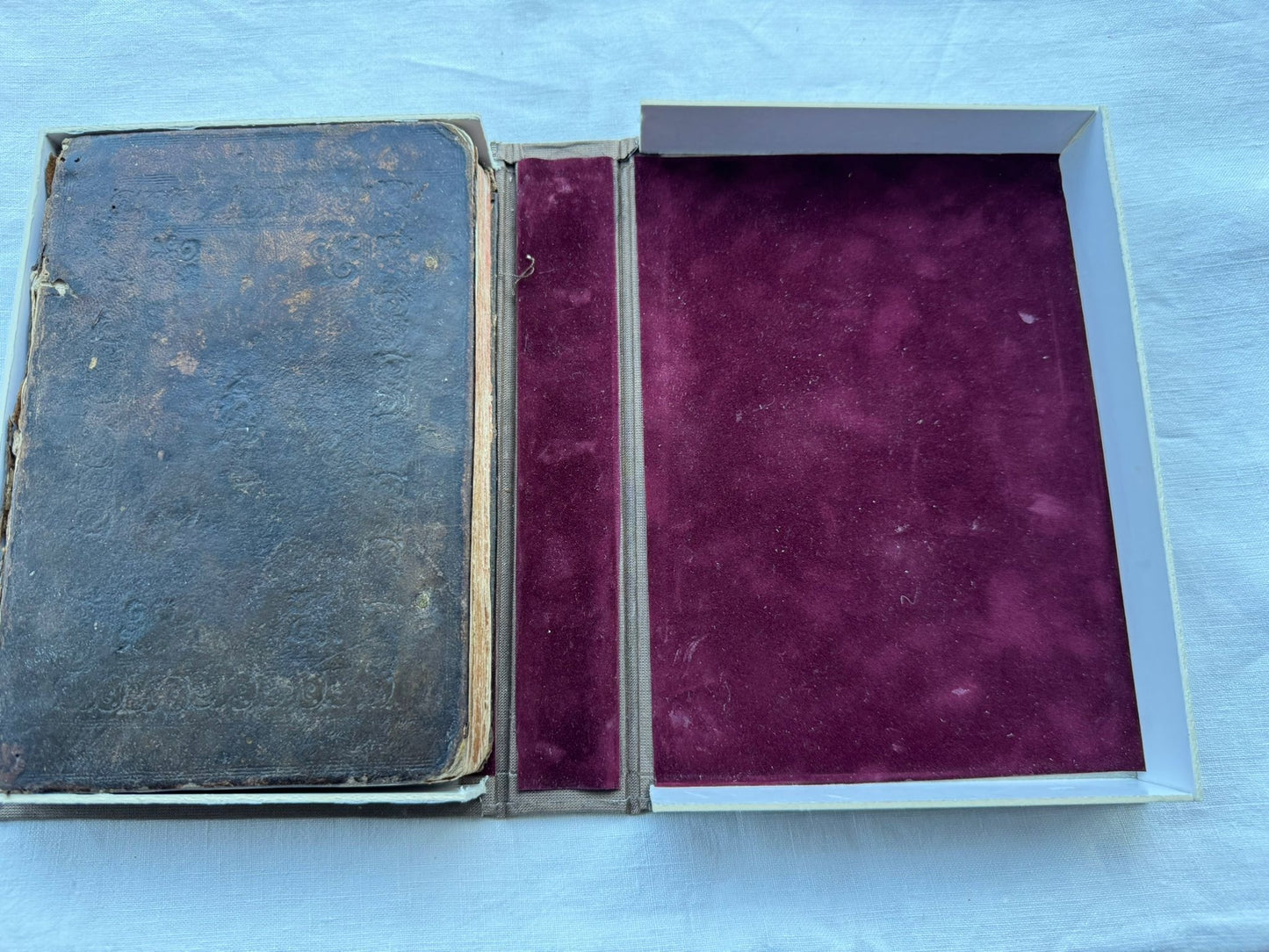
-Small format manuscript on paper (19.5 x 13 cm; binding 20 x 13 cm).
-Bound in its original binding of blind-tooled calf.
-Complete: 84 leaves. Written in a clear late 16th-century hand on 8 four-line red staves with square notation.
-Very good condition: some finger-soiling, occasionally heavier; a few marginal pen trials and baroque sketches to rear board. New 19th Century fly leaves crudely inserted. Contemporary binding worn with loss to spine at hinges and worming to inner boards.
A finely executed late Renaissance choral manuscript produced for the Carthusian house of Maggiano, near Siena, and dated in the colophon to 2 April 1599. The manuscript includes a calendarium and a table of movable feasts covering the years 1599–1618.
The music includes numerous calligraphic initials in red and pale blue, alongside larger initials heightened with gold and colour. The decoration is restrained, characteristic of Carthusian austerity. The musical notation is clear and carefully spaced, with black square neumes on red four-line staves, reflecting the standardisation of chant books following the reforms of the Council of Trent.
Particularly noteworthy are the local additions to the calendar, including saints associated with the region such as Bernardino of Siena (20 May) and Lorenzo Giustiniani (8 January). The inclusion of a computus table for movable feasts extending nearly two decades suggests practical liturgical use.
The Carthusian monastery of Maggiano was founded in the 14th century, and was part of a wider network of austere and intellectually rigorous communities. Manuscripts from Carthusian contexts are often marked by their clarity, discipline, and relative lack of ostentation compared to Benedictine or Franciscan counterparts, making this example a particularly attractive survival of late manuscript culture in an age increasingly dominated by print.
The manuscript bears ownership inscriptions of the Carthusian house (“Carthusie Maggiani” and “Carthusie S. Mariae prope Senas Maggianorum”). The manuscript later entered the celebrated collection of Baron Horace de Landau (1824–1903), one of the great 19th-century collectors of Italian manuscripts.
Complete portable manuscript choirbooks with clear origin, provenance, and a contemporary binding, are increasingly uncommon on the market.