

De Bry Rare Books
Nil Darpan - Calcutta 1861 - Dinabandhu Mitra - One of 500 copies of the controversial first english translation
Nil Darpan - Calcutta 1861 - Dinabandhu Mitra - One of 500 copies of the controversial first english translation
Couldn't load pickup availability
One of 500 copies of the controversial first english translation
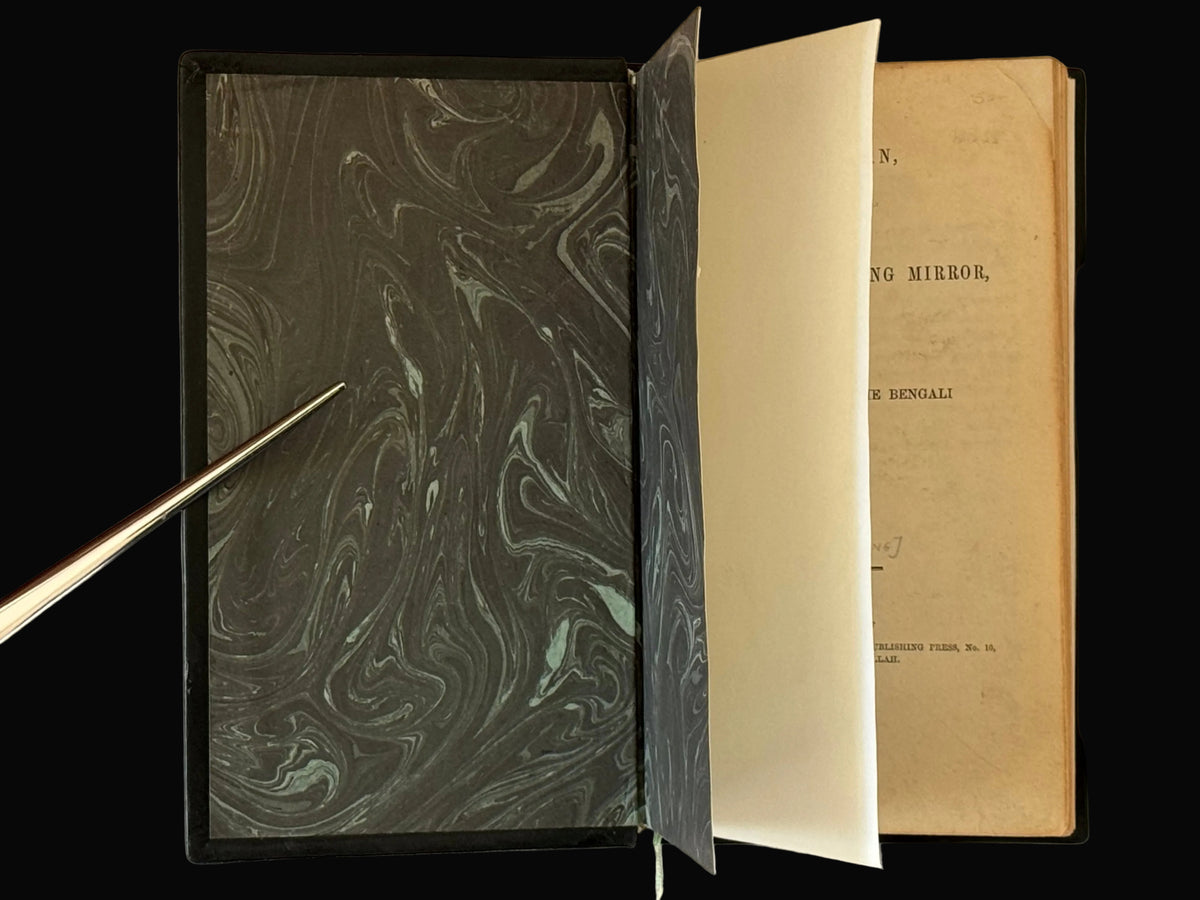
"Nil Darpan, or the Indigo Planting Mirror, a Drama."
"Translated from the Bengali by a Native. Calcutta: C. H. Manuel, 1861."
-By Dinabandhu Mitra
-Translation attributed to Michael Madhusudan Dutt
-First edition - Printed in an edition of 500 copies
-8vo, 20th-century leather by Frederico d'Almeida, Lisbon
-Complete: iv 102 pp. Very good condition
"Nil Darpan", translated into English as "The Indigo Planting Mirror", was written by the Bengali playwright Dinabandhu Mitra in 1859. The play takes place in the context of the Indigo Revolt (Nil Bidroha) of 1859-1860 in Bengal. In the lead up to the revolt, British planters had forced Bengali farmers (ryots) to grow indigo under exploitative contracts. Farmers were forced to take unpayable loans up front and then sell their indigo at artificially low prices. Planters used private militia (Latials) to intimidate the poorer farmers, and were backed by colonial authorities. Indigo exhausted the soil's fertility, and was planted instead of food crops such as rice, contributing to food shortages and the 1866 Orissa famine.
The Indigo revolt started as a non-violent protest in 1859 but escalated to widespread resistance and attacks on Indigo factories. A government commission in 1860 supported the farmers' rights, and enacted legislation which stated that farmers could not be forced to grow Indigo.
Nil Darpan was written in the context of this revolt. It exposed the brutality of the British Indigo planters and mobilised the local urban elite to the plight of the rural farmers. After initial publication in Bengali in 1860, the author Mitra sent a copy of the play to the Reverend James Long of the Church Missionary Society in Calcutta. Long arranged a translation, attributed to the celebrated poet and playwright Michael Madhusudan Dutt, and published the work in Calcutta in 1861 in an edition of 500, with support from Lieutenant Governor Sir John Peter Grant.
The publication caused uproar among the local British planter elite, and Long was taken to court where he was found guilty. He was fined 1000 rupees and sentenced to one month in jail.
In 1872, the play was famously chosen to be the first play to be staged at the new National Theatre in Calcutta under the director Girish Chandra Ghosh. Due to its popularity and anti-British sentiment, the play contributed to the introduced of the "Dramatic Performances Act of 1876", which allowed them to censor plays which promoted distrust of British rule.
Due to the play's controversy, surviving copies are scarce. Nine institutional copies only are traced through OCLC: BL, Oxford, Liverpool, Israel, Yale, Cleveland, Chicago, Uni California, Alberta.